


The Promise Operators are Struggling to Keep: Why Responsible Advertising Is the Real Test of Africa’s Gaming Boom

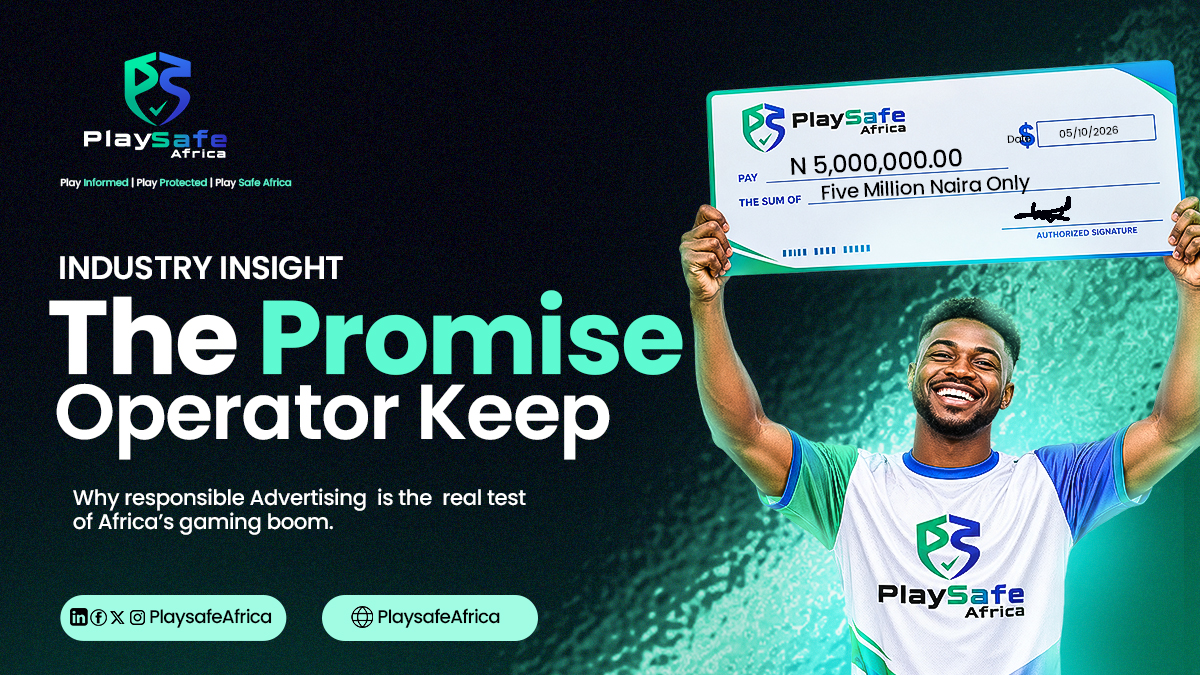
There is a particular kind of billboard you learn to recognise driving through Lagos, or Nairobi, or Accra at night, lit brighter than the shops beneath it, a man mid-celebration, arms thrown skyward, a number beside him too large to be anything but bait. You have seen it. Everyone has seen it. And somewhere behind that image sits a quieter, more uncomfortable fact, the man in the photograph is not a promise. He is the exception the whole industry is designed to project; just often enough to keep the lights on that billboard and keep the dices rolling.
Africa’s betting industry did not arrive quietly, and it has not grown quietly either. Nigeria’s market alone now clears $3 billion, carried by tens of millions of bettors who place their wagers between traffic and lunch breaks, thumbs moving faster than the odds can update. Kenya, South Africa, and Ghana are close behind, each writing their own chapter of the same story. It is, on its own terms, a success a young, digitally fluent continent building an entertainment economy almost entirely on its own infrastructure. But every industry that grows this fast eventually meets the version of itself it has been outrunning, and for gaming operators across the continent, that reckoning is arriving through the one channel they trust the most, their own advertising.
Look closely at what that advertising says, Not the fine print in the message. The jingles that frame a bet as a shortcut to the good life. The influencers, some courting audiences barely past adolescence, posting screenshots of six-figure wins with the casualness of a restaurant review. The language everywhere is the language of certainty guaranteed, sure, your turn deployed against a product whose entire mathematical architecture depends on most people losing. That is not persuasion stretched a little thin. That is a lie told in the grammar of encouragement, visualization of a good life promised, and a lie told well and often enough, stops feeling like a lie.
The regulators noticed before most operators did. Nigeria’s Advertising Regulatory Council, now working in step with the Federation of State Gaming Regulators, rolled out harmonised advertising rules this year aimed squarely at the gap between what gets promised and what gets delivered. They have implemented the incorporation of tighter language, mandatory responsible-gambling messaging, which gives less room to hide behind creative interpretation. The National Lottery Regulatory Commission has drawn its own line. Just as plainly, advertising that could reach or appeal to minors, or that skips the safety messaging entirely, no longer passes as acceptable practice. Kenya, South Africa, and Ghana are converging on the same territory from their own directions. This is not a mood regulator will grow tired of. It is the trajectory where the whole continent is heading, and the operators still treating it as a phase, will feel it hardest when it turns out not to be one.
But regulation is the blunt version of this problem. The finer version the operators actually need to solve for themselves, it is knowing where the line sits between advertising a product and projecting an unrealistic outcome. That line is easy to state and surprisingly hard to hold, because almost no operator sets out to cross it. It gets crossed one incremental campaign at a time, each one slightly bolder messaging than the last, signed off by people who are too close to their own acquisition targets to see the drift.
There is a simple way to test for it, and it does not require a regulator or an auditor, just honesty about what the advert is claiming. The question to ask is first whether the campaign is selling the experience or the result, does it invite someone into the thrill of a matchday, or does it dangle the money itself as the reason to play? Another question is if the advert could survive being read literally by the most vulnerable person likely to see it, and not by the savvy weekend bettor who knows the odds, or even by the nineteen-year-old certain this would cover his rent.
Another question is if the campaign would still feel honest with the losses shown alongside the wins, because an advert that only survives by omission was never honest to begin with. Very few campaigns currently running across Lagos, Nairobi, or Accra would pass all three questions. That is not a moral failing so much as a structural or procedural one. Nobody built the checkpoint, so nobody stops to use it.
None of this asks operators to go quiet, or to apologise for offering something people genuinely enjoy. Betting, done honestly, is entertainment. The noise of a matchday, the shared superstition of a group chat, the small thrill of being right. Sell that. Sell the feeling, the platform, the community around the screen. What no operator can keep selling, not for much longer, is the outcome and the implication that the win is coming, that losses are rare or reversible, that the house has quietly stepped aside just this once.
The truth also has a weight distribution problem, and it does not fall evenly. It lands heaviest on the young man still working out what money means to him, on the bettor chasing rent, or anyone already circling the edge of losing control over their own play. An advert that nudges any of these people toward believing the win is close, or that betting is a plan rather than a gamble, is not clever marketing. It is a small, repeated failure of duty, dressed carefully enough to pass as enthusiasm.
Africa’s gaming industry has earned its growth honestly. What it has not yet earned, not fully, is the public’s belief in what it says about itself and that belief will not be rebuilt by regulation alone, because regulation only ever catches what is already gone too far. It will be rebuilt by operators running their own campaigns through questions like these before a regulator ever has to. PlaySafe Africa exists, in part, to help operators do exactly that independently, and before the cost of getting it wrong catches up with them.