


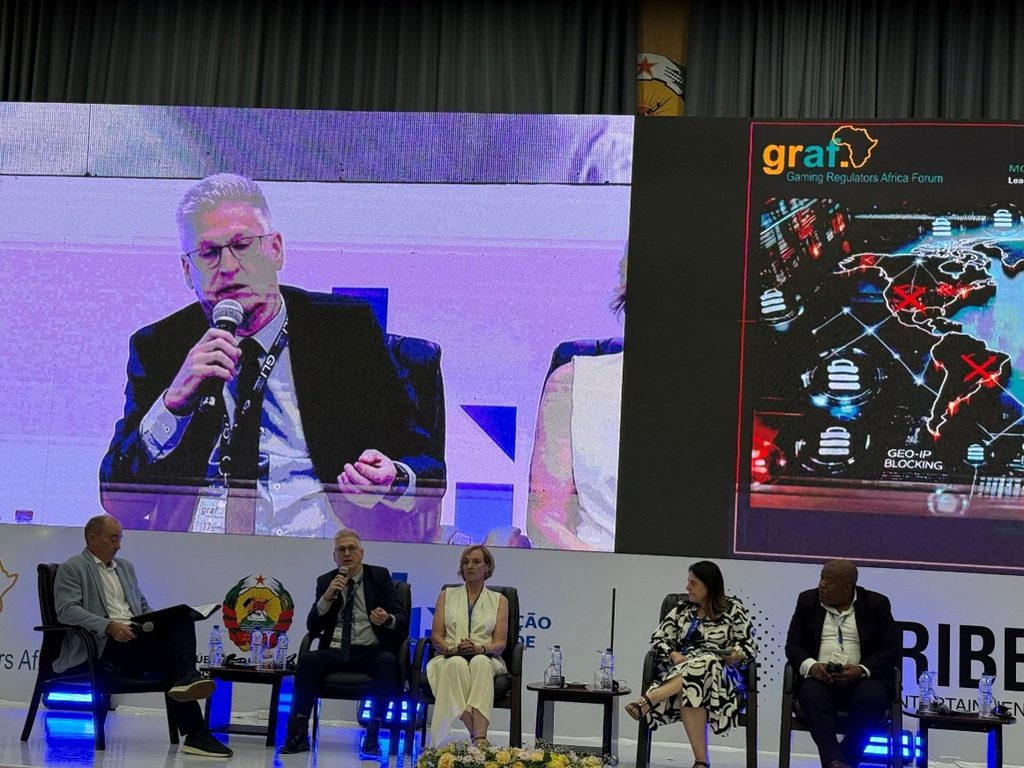
At the Gaming Regulators Africa Forum (GRAF 2026) in Maputo, Mozambique, industry leaders, regulators, and consultants gathered for a high‑level panel discussion on one of the continent’s most pressing challenges: illegal online gambling.
Illegal gambling is no longer simply a regulatory issue, it has become a legislative, technological, financial, and cross‑border challenge. Offshore operators can reach African consumers, process local payments, and access legitimate gambling content while remaining beyond the effective reach of national regulators.
South Africa has begun pursuing website blocking and intelligence‑led enforcement, while emerging strategies across the continent seek to disrupt payments, advertising, technology, and the licensed B2B supply chain. The central question remains: Can national laws and regulators keep pace with a market that operates without borders?
Key Insights from the Panel, according to Ms. Wendy Rosenberg, Director & Head of Digital Media and Electronic Communications Practice at Werksmans Attorneys, emphasized the importance of creating a verified list of legal gambling operators. “It may be a very clear campaign to banks, advertisers, and ISPs. This is who’s legal, this is not, giving them a clear roadmap to act without fear of liability,” she explained.
Mr. Lungile Dukwana, Acting CEO of the National Gambling Board, highlighted the need to follow the money. He stressed that payment disruption is one of the most effective tools against illegality. “That is where you hit the most in the pocket. We are working with banks and payment operators to ensure unlawful wins are disrupted and enforcement is sustainable,” he said.
Mr. Pierre Otto, General Manager of GLI Africa, noted that tackling illegal gambling requires multiple approaches. He pointed out that if consumers cannot deposit funds into illegal sites, the market shrinks significantly. He also suggested that legalizing certain products could help close the gap, as consumers often turn to the black market when regulated options are unavailable.
Ms. Anne‑Marie Pooley, Gambling Consultant, echoed the need for collaboration. “We’ve been talking about the same issues for years. It’s time to stop talking and start working together. Regulators across Africa must share experiences, form work groups, and report back with successes rather than repeating the same conversations,” she urged.
From the moderator’s perspective, the session was moderated by Mr. Sean Coleman, CEO of the South African Bookmakers’ Association, who summarized the challenge: “Illegal gambling cannot be solved by the regulator alone, by legislation alone, or by technology alone. The response has to be cumulative, making the illegal market harder to find, harder to access, harder to pay, harder to supply, and harder to sustain, while ensuring the regulated market is the one customer choose.”
In conclusion, the panel underscored that tackling illegal gambling in Africa requires smarter enforcement, stronger legislation, advanced technology, and cross‑border collaboration. By disrupting payments, clarifying legal operators, and working collectively, regulators can protect consumers while strengthening the legitimacy of the regulated market.
GRAF 2026 continues to serve as a platform for bold conversations and actionable strategies to shape the future of Africa’s gaming ecosystem.