
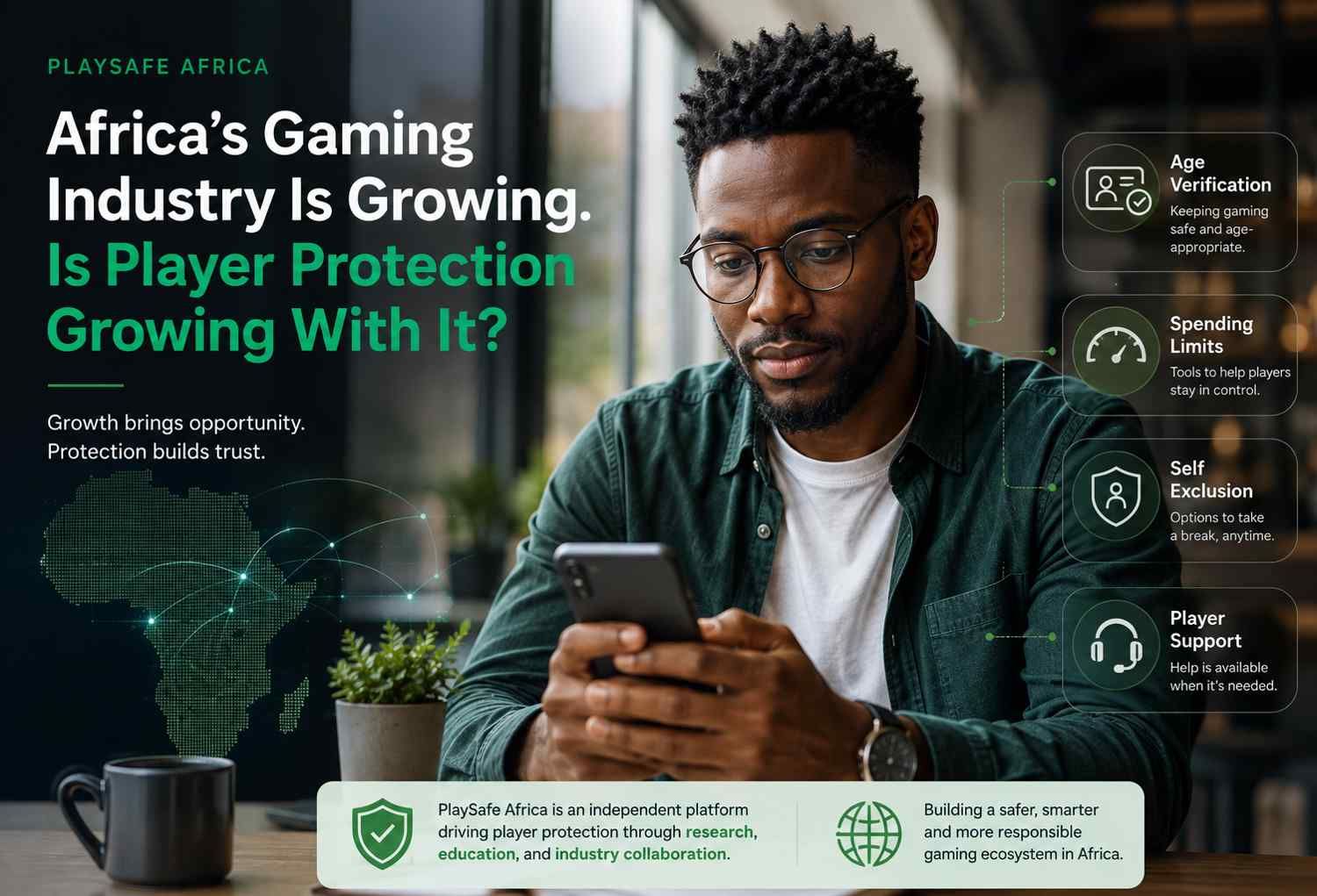

Africa’s gaming industry is accelerating. Smartphones, expanding internet access, mobile payments and digital platforms have made gaming more accessible than ever; what once required a trip to a physical betting shop can now happen in seconds, from almost anywhere. That shift raises a question deserving as much attention as the growth itself: as access to gaming becomes easier, are the systems designed to protect players keeping pace?
The honest answer is not evenly, and not yet. Responsible-gaming requirements are taking shape and regulatory systems are evolving, but implementation, evidence and access to practical protection tools still vary widely across markets. That inconsistency is the gap PlaySafe Africa was created to close.
Growth Has Quietly Changed the Risk
Gaming’s growth cannot be separated from Africa’s wider digital transformation; it has simply inherited infrastructure built for everything else. Sub-Saharan Africa accounted for more than half of the world’s registered mobile-money accounts, and 66% of global mobile-money transaction value, in 2025, according to GSMA data reviewed in the PlaySafe Africa 2026 brief, the same financial rail that now powers deposits and withdrawals across gaming platforms.
A physical gaming environment naturally built in pauses: travel, a conversation with another person, fixed hours. Digital gaming has removed much of that friction. That does not prove digital access causes more harm, but it does mean protective friction has disappeared faster than digital safeguards have replaced it. The real question is whether player protection is being deliberately built into that growth.
Regulation Is Necessary, Not Sufficient
Regulation is naturally the first place people look: licensing, age verification, spending limits, self-exclusion, enforcement. On paper, there has been real progress. The PlaySafe Africa 2026 brief found responsible-gaming requirements, including self-exclusion, age verification and deposit limits, now present across all six markets it examined: Nigeria, Ghana, Kenya, South Africa, Tanzania and Uganda.
But regulation on paper and protection in practice are not the same thing. Operator-level compliance data was not publicly available for any of the six markets, making consistent enforcement hard to verify. Self-exclusion shows the gap clearly: if it only applies to one operator, a player can simply move to another platform and the protection disappears with the switch. The brief found no evidence of a centrally enforced, cross-operator self-exclusion registry in any of the six markets. A tool that exists on paper is not the same as a tool that actually works.
Beyond “Play Responsibly”
The responsible-gaming conversation has too often shrunk to awareness alone. Messages urging players to set limits or play responsibly matter, but education was never built to carry the whole weight of protection alone. The PlaySafe Africa brief found stronger evidence for structural interventions, such as pre-commitment and enforced limit-setting, than for education-based messaging on its own, and argues for combining both. Operators, regulators, technology providers, researchers and civil society all share responsibility too; players need usable tools, not just messaging. That is the space an independent platform is built to fill.
Why PlaySafe Africa Was Created
PlaySafe Africa is Africa’s first independent responsible-gaming platform dedicated to player protection, responsible-gaming standards, compliance, research and consumer protection continent-wide, and its independence is central to its purpose. Operating independently of gaming operators and backed by Saldrey Communications, it was created to address the limited availability of independent responsible-gaming education, research, compliance resources and player support across the region.
Its mission is to promote responsible gaming and protect players through education, research, certification, advocacy and evidence-based interventions. The ambition goes beyond messaging, building an ecosystem that connects education and self-help resources for players, compliance and certification for operators, and evidence for regulators, shifting responsible gaming from a message into a system.
Knowledge. Tools. Support. All in One Place.
The PlaySafe Africa website makes that system tangible, built around the Player Education Hub, an independent resource centre offering practical guidance, self-help tools and support information, including on self-exclusion and referral services. It also includes practical tools such as a spending-limit calculator, turning “set a limit” from abstract advice into something a person can actually do. If player protection is going to work, it has to be something people can understand and act on directly, not simply something they are told, and that principle runs through the whole platform.
Built for the Whole Ecosystem, Not Just Players
Player protection cannot be solved by educating players alone, so PlaySafe Africa’s work reaches into compliance guidance, certification, research and industry insight for the wider ecosystem. Players need usable information; operators need practical compliance guidance; regulators need evidence and visibility into emerging challenges; researchers need Africa-specific data; communities need accessible consumer-protection support. PlaySafe Africa connects those needs while maintaining independence from operators throughout, because trust is central to responsible gaming, and an organisation built for player protection has to hold a visible, consistent commitment to evidence, integrity and responsibility.
Africa Does Not Need to Copy Another Market
Africa is not one gaming market. Nigeria, Ghana, Kenya, South Africa, Tanzania and Uganda already show very different regulatory structures and institutional capacity: Nigeria and Kenya are mid-transition, South Africa’s regulatory environment is comparatively mature, Tanzania runs real-time monitoring through GREMS, and Uganda operates its own national electronic monitoring system.
Solutions built for another part of the world cannot simply be dropped into every African market and expected to work the same way; Africa needs approaches built around its own digital, financial and regulatory realities. Its mobile-money infrastructure, already trusted and widely used, has real potential to support enforceable limit-setting directly, not just move money. The opportunity was never to import standards, but to build stronger ones.
From Evidence to Action
PlaySafe Africa’s 2026 brief identifies real gaps: limited audited market data, gaps in verifying operator compliance, uneven institutional capacity, limited Africa-specific research, and a mismatch between popular responsible-gaming approaches and the evidence behind them. None of this is solvable by one organisation alone; it requires collaboration, better research and data, and regulators, operators and technology providers willing to share what they know. The brief proposes a player-protection ecosystem built on eight pillars, education, prevention, protection, monitoring, intervention, support, collaboration and measurement, and PlaySafe Africa exists to help advance it.
The Future of African Gaming Should Include Protection
Africa’s gaming industry will keep evolving, its infrastructure changing and regulation maturing. The question was never whether that growth should happen; it is what kind of ecosystem Africa builds around it. Success should be measured not only by revenue or reach, but by whether players are informed, protection tools are accessible, regulators have reliable evidence, operators have clear standards, and stakeholders work together rather than in isolation.
PlaySafe Africa was created because those questions deserve an independent, African-focused platform built on integrity, evidence and collaboration.
Africa’s gaming industry is growing. Now, player protection has to grow with it.
Play Informed. Play Protected. Play Africa.