

Africa’s $23 Billion Online Gambling Opportunity: The Race to Win Back the Market Has Already Begun

For years, conversations about Africa’s online gambling industry have centred on one question: How do regulators control the market?
Again, consumers experience one online gambling marketplace comprising regulated and unregulated sectors.
A new continent-wide report suggests they may have been asking the wrong question.
According to Gaming Compliance International’s (GCI) Online Gaming 2024-2025: Africa report, the real challenge is no longer simply regulating licensed operators. It is ensuring that Africa’s regulated market becomes attractive enough for consumers to choose it over thousands of unlicensed alternatives.
The Report paints a picture of an industry that is not struggling with demand; it is struggling with consumer channelisation.
The opportunity is enormous.
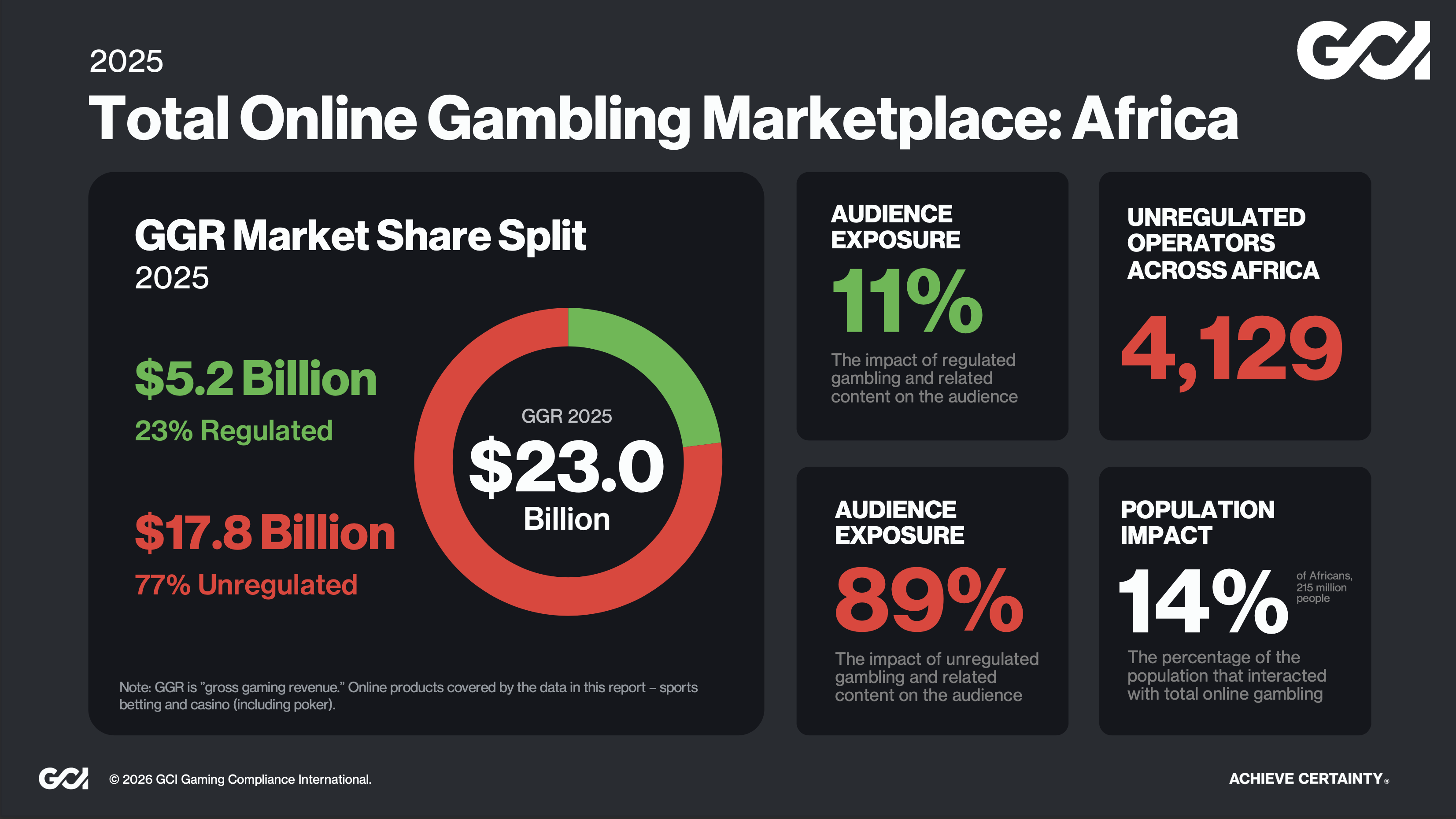
Africa’s online gambling market generated $23 billion in Gross Gaming Revenue (GGR) during 2025, growing from $20 billion in 2024. More importantly, the regulated sector is moving in the right direction. Licensed operators increased their share of the market from 22 percent to 23 percent, with regulated revenues climbing from $4.4 billion to $5.2 billion in just twelve months.
Those may appear to be incremental gains, but they demonstrate that when regulation becomes commercially competitive, consumers respond.
“For the first time, we can see the whole of Africa’s online gambling market clearly. Nation by nation, across two full years, the picture is encouraging,” said Matt Holt, Chief Executive Officer of Gaming Compliance International.
“The regulated sector is growing, and in several countries, it is starting to gain ground. That tells us these tools work. Our job is to give regulators a complete and honest view of their own market, so they can build on the progress this data now shows.”
The Market Is Already Here
One of the report’s biggest takeaways is that Africa does not need to create a gambling economy; it already has one. An estimated 215 million Africans, representing 14 percent of the continent’s population, interacted with online gambling during 2025, up from 198 million people the previous year. Consumer participation continues to grow across virtually every region.
Today, most of it still flows outside regulated markets. Unlicensed operators generated $17.8 billion in revenue during 2025 up from $15.6 billion in 2024 and continue to account for 77 percent of Africa’s online gambling economy. During the same period, the number of unregulated operators targeting African consumers increased from 3,644 to 4,129.
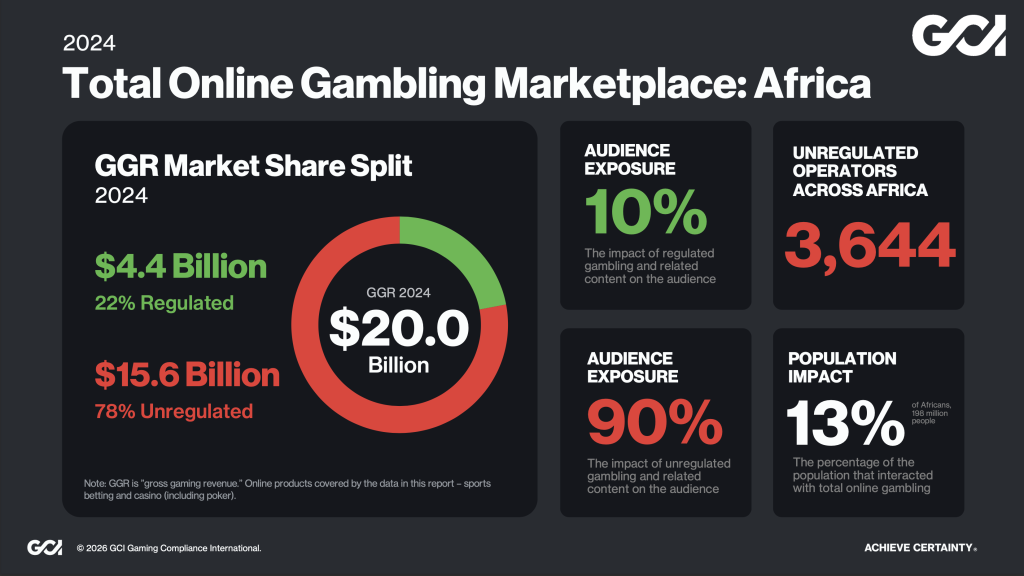
For an industry built around digital acquisition, visibility remains one of the biggest battlegrounds. While licensed operators improved audience exposure from 10 percent to 11 percent, almost nine out of every ten gambling interactions online still direct consumers toward unregulated brands.
Regulation Needs a New Playbook
Perhaps the most significant contribution of the report is not the numbers; it is the thinking behind them. GCI argues that regulators have traditionally focused on supervising licensed operators while largely ignoring the wider digital ecosystem that enables illegal gambling to flourish.
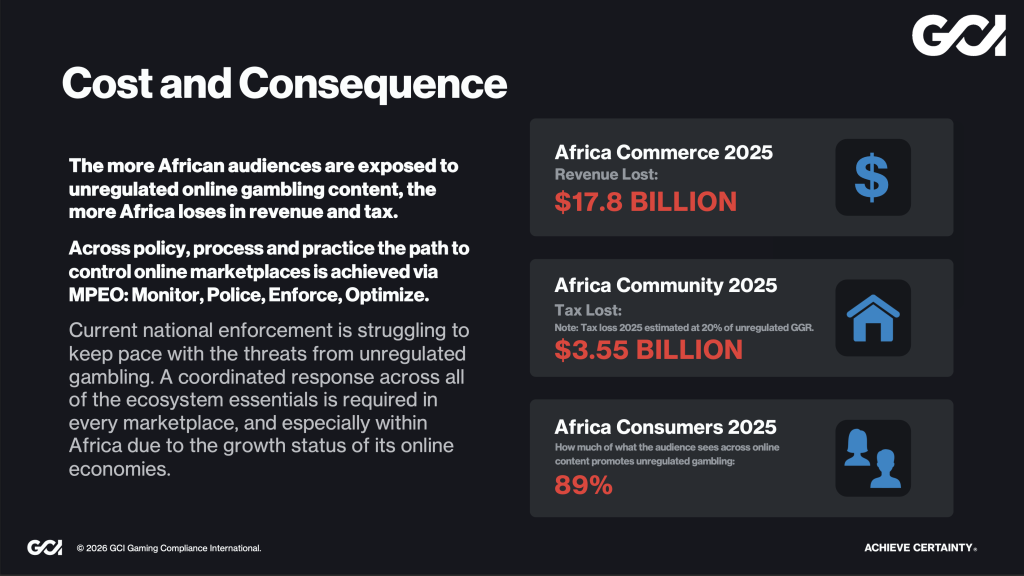
According to GCI, effective regulation cannot rely on enforcement alone. Unless oversight extends across the entire digital ecosystem that supports online gambling from payment systems and search platforms to affiliate networks and digital advertising unlicensed operators will continue to outpace regulated businesses. To address this, the report proposes its MPEO framework, which urges regulators to monitor the full marketplace, police unlicensed operators, enforce regulatory integrity, and optimise the licensed sector to ensure it remains attractive, accessible and competitive. The approach marks a significant evolution in regulatory philosophy, shifting the measure of success from the number of licences issued to the extent to which consumers actively choose regulated operators over illegal alternatives. It is measured by whether consumers actually choose licensed operators.
Competition Matters
One of the report’s strongest arguments is that regulation and competitiveness are no longer separate conversations. When customer taxes become excessive, payment systems create friction, products become overly restricted or licensing becomes unnecessarily burdensome, consumers rarely stop gambling. They simply migrate elsewhere.
The result is a marketplace where compliant operators lose ground, governments collect less revenue and consumers receive fewer protections.
The report also highlights encouraging signs across the continent. West Africa currently records Africa’s strongest regulated market share, followed closely by Southern Africa.
Nigeria continues to lead among Africa’s major gambling markets, with the lowest proportion of unregulated activity at 56 percent, while Ghana continues to strengthen its regulatory position. Neither market is perfect. But both demonstrate that consistent regulation, accessible licensing and stronger enforcement can gradually pull consumers back into regulated channels.
The Industry’s Biggest Opportunity
For Ismail Vali, President of Gaming Compliance International, the conversation should now move beyond discussing the size of the illegal market. The focus should be on the opportunity it represents. “Africa’s online gambling marketplaces should not be defined by their challenges. They should be defined by their opportunity,” Vali said.
“Millions of consumers already participate in online betting and gaming, creating substantial economic activity and the potential to deliver sustainable local commerce, public revenues and safer consumer outcomes. The challenge is not creating demand. The challenge is ensuring that demand is captured within the regulated sector.”
He believes marketplace outcomes not enforcement statistics should become the benchmark for regulatory success.
“The objective is not simply to regulate licensed operators. The objective is to optimize the entire online gambling marketplace so that consumers choose to enter, remain within, and benefit from the regulated sector.” That philosophy could reshape how Africa approaches gambling regulation over the next decade.
Rather than asking how many operators have been licensed, governments may increasingly ask how much consumer activity has been successfully channelled into regulated markets, how much tax revenue has been retained locally, how effectively consumers are protected and whether legitimate operators can compete fairly against offshore rivals.
The Next Phase of Africa’s Gaming Industry
Africa’s online gambling industry is no longer an emerging market. It is a $23 billion digital economy with more than 215 million participants. The opportunity is no longer about stimulating demand; it already exists.
The next chapter will be written by regulators and operators that recognise marketplace optimization as the real competitive advantage.
For an industry increasingly driven by data, technology and consumer choice, the winners will not necessarily be those with the toughest rules. They will be those that build regulated markets consumers actually want to use. Because in the end, the future of Africa’s gaming industry will not be determined by how much gambling takes place. It will be determined by where consumers choose to gamble and whether regulation has created a marketplace worth choosing.
Link here to read the full report.